
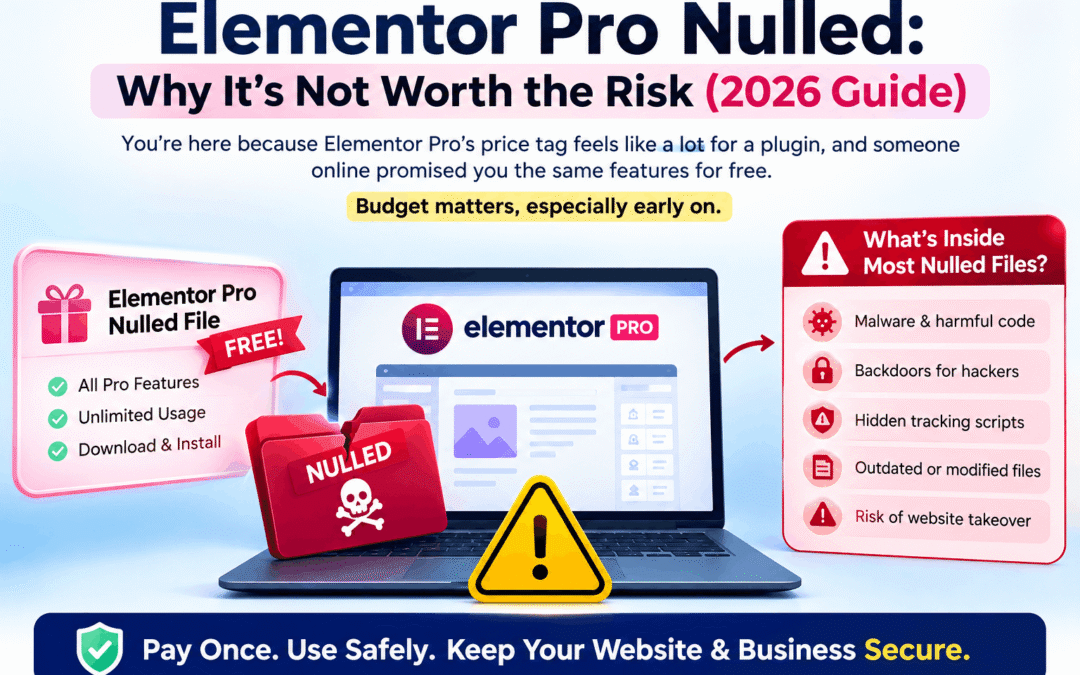
You're here because Elementor Pro's price tag feels like a lot for a plugin, and someone online promised you the same features for free.
That's a completely understandable place to be. Budget matters, especially early on.
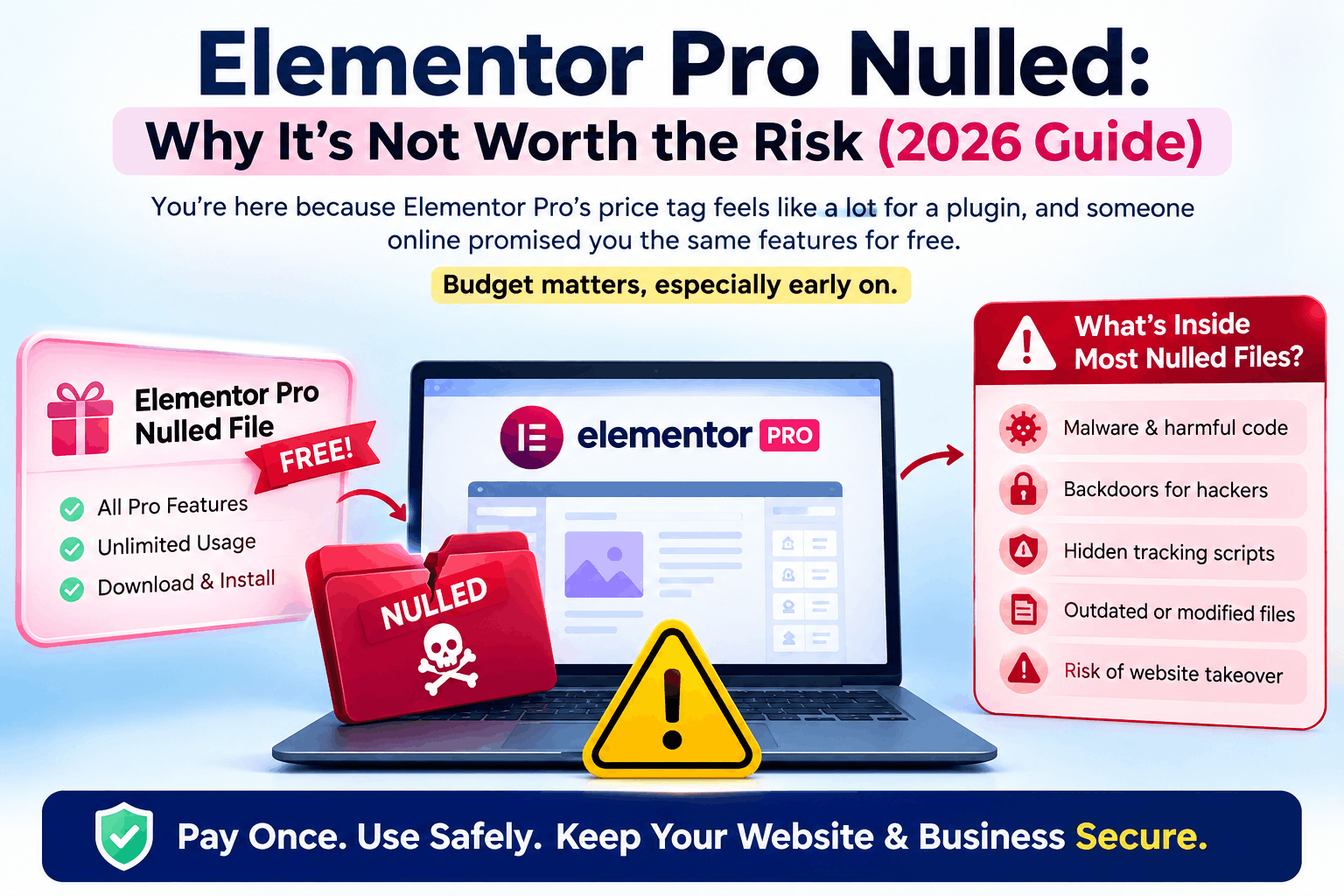
But before you download anything, here's what's actually inside most "nulled" Elementor Pro files — and it's not just Elementor Pro.
Quick Answer
Nulled Elementor Pro is a pirated copy with license verification stripped out, usually downloaded from a third-party site instead of Elementor.com.
An independent study by Microsoft, IDC, and the National University of Singapore found a 33% chance of malware infection when installing pirated software.
That's roughly a 1-in-3 chance you're installing more than just a page builder. Here's what that actually looks like in practice.
What "Nulled" Actually Means
A nulled plugin is the real, paid code — with the license-check removed so it runs without a purchased key.
Distributing WordPress plugins isn't automatically illegal, since most WordPress software inherits the GPL license, which explicitly permits redistribution. That's the part nulled sites lean on to seem legitimate.
Here's the part they don't advertise: the sites distributing nulled copies have a strong incentive to modify the code before handing it to you, and security researchers keep finding exactly that — backdoors, hidden admin accounts, spam injection, and credential stealers packaged inside.
The GPL makes redistribution legal. It says nothing about what got added before it reached you.
The Malware Isn't Hypothetical — It Has a Name
This isn't a vague warning. There's a documented, widely studied malware family built specifically around this exact behavior.
WP-VCD spreads by injecting itself into legitimate plugins and themes, then propagating through sites that offer nulled downloads — it's one of the most thoroughly documented WordPress infections that exists, and it built its entire distribution network on exactly the download habit you're considering right now.
The malicious code inside nulled software may sit dormant for weeks or months before activating — establishing a backdoor, injecting hidden spam links, harvesting credentials, or waiting for a signal from a remote server.
Here's the detail that matters most: because the malicious code lives inside software you deliberately installed, it often survives basic malware scans that only check for known external attack signatures.
Your site can look completely clean and still be compromised.
Why "I'll Just Update It Later" Doesn't Work
Nulled plugins don't connect to Elementor's official update servers — the license check that got stripped out is the same mechanism that verifies updates.
That matters more than it sounds like, especially right now. In August 2026, security researchers disclosed CVE-2026-32475, a critical Elementor Pro vulnerability allowing unauthenticated attackers to upload and execute PHP code through a common Form widget configuration.
Elementor patched it fast, in version 4.2.2. If you're running a nulled copy, you're not getting that patch — you're stuck on whatever version you downloaded, indefinitely, with a documented remote-code-execution hole sitting wide open.
That's not a rare situation. 91% of newly disclosed WordPress vulnerabilities in 2025 were found in plugins, not WordPress core — and the median time from disclosure to mass exploitation for heavily targeted vulnerabilities was just 5 hours.
Legitimate users get the patch. Nulled users get the vulnerability, permanently.
How This Actually Plays Out on a Real Site
This isn't just theory. Warning signs site owners report after installing nulled plugins follow a consistent pattern:
- Unexpected redirects. Visitors get bounced to spam pages or unfamiliar search results — a classic sign of injected redirect code.
- A sudden drop in organic traffic. Search engines flag and penalize sites carrying spam links, even ones the owner never knowingly added.
- Unexplained slowdowns. Compromised files and background malware processes eat server resources your visitors never asked for.
- New admin accounts you didn't create. A planted backdoor account is one of the most common ways attackers maintain access after the "obvious" malware gets cleaned up.
Any one of these on its own might have another explanation. Two or three together, right after installing a nulled plugin, is not a coincidence.
"But I Found One From a 'Trusted' Site"
There's no such thing, and this is worth being direct about.
Security researchers analyzing WP-VCD found that every sample they tested — across multiple different "premium download" sites — contained the same injected malicious files, regardless of which site distributed them or how professional the site looked.
A polished website, real-looking reviews, and a legitimate-sounding name don't tell you anything about what's actually in the ZIP file. The professionalism of the download site has never correlated with the safety of the download.
The Real Cost Comparison
Here's the math nulled-software sites don't want you running.
Elementor Pro's legitimate license costs a fraction of what a single cleanup after a real infection runs. Malware removal, credential resets, lost search rankings, potential data breach disclosure obligations, and the time your site spends broken while you fix it — that bill adds up fast, and it's not optional once you're infected.
Thousands of WordPress sites get compromised every year, and a surprising number of those infections trace directly back to one decision: installing a nulled plugin.
The "savings" were never really savings. They were a cost deferred, with interest.
What to Do Instead
If budget is the real constraint — and it often genuinely is — here's what actually helps without the risk:
- Use Elementor's free version. It's genuinely capable for a huge range of sites, and it's the same core codebase without the malware lottery.
- Watch for official sales. Elementor runs legitimate discount periods; a 40–50% off legitimate license is a real, safe version of the "deal" nulled sites are impersonating.
- Check if your host bundles it. Some managed WordPress hosts include Elementor Pro or equivalent page builders as part of their plans.
- If you've already installed a nulled plugin, treat the site as potentially compromised now, not later. Run a full scan with a reputable scanner, and don't assume "it looks fine" means it is fine — as covered above, that's exactly what this malware is built to look like.
The Bottom Line
The searches for "Elementor Pro nulled" almost always come from the same honest place: wanting a good tool without the price tag attached to it right now.
That instinct isn't the problem. The specific shortcut is.
A nulled plugin doesn't just risk your Elementor site — it risks whatever database, customer data, or reputation is sitting behind it, running on outdated code with a documented history of hidden backdoors.
FAQ
Is downloading nulled Elementor Pro illegal? Distribution of GPL-licensed WordPress software is often technically legal under the GPL, but the modified, malware-laden versions distributed on nulled sites go well beyond simple redistribution — and using them carries real security and operational risk regardless of the legal question.
Can nulled Elementor Pro really contain malware? Yes. Documented malware families like WP-VCD specifically target nulled WordPress plugin and theme distribution as their infection method, and independent research puts the odds of malware in pirated software at roughly 1 in 3.
Will a nulled plugin get security updates? No. The license verification that nulled versions strip out is tied to the same system that delivers official updates, so nulled installs are permanently frozen on whatever version was downloaded — including any unpatched vulnerabilities.
How do I know if my site is already infected from a nulled plugin? Watch for unexpected redirects, a sudden organic traffic drop, unexplained slowdowns, or unfamiliar admin accounts — and run a full malware scan rather than assuming a clean-looking site is actually clean.
Is there a legitimate free alternative to Elementor Pro? Elementor's free version covers a wide range of use cases with the same core codebase, and official discount periods offer a safe way to access Pro features at a reduced price.
